
John McCarthy, MD: A Psychiatrist’s Spiritual Reckoning Inspires a Haunting Debut Novel
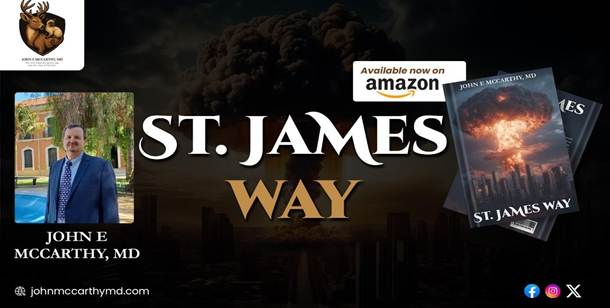
The author of St. James Way blends personal grief, global unrest, and mystical vision into an urgent literary journey.
John McCarthy, MD, never set out to be a novelist. For decades, he lived the structured life of a psychiatrist—an engineer turned doctor, a man of reason, trained to diagnose and treat. But underneath the white coat, McCarthy was unraveling. Haunted by his brother’s death, undone by addiction, and disillusioned by religion, he found himself chasing answers that couldn’t be found in textbooks.
Now, with his literary debut, St. James Way, McCarthy offers something rare: a deeply personal
yet universal story that crosses the borders of time, geography, and belief. It’s a novel that doesn’t just ask what it means to live—it asks what it means to keep living after everything you’ve built has collapsed.
The novel’s emotional engine is McCarthy’s brother, Rick. A gifted young man—athlete,
musician, and McCarthy’s closest companion, Rick suffered from epilepsy in his teens and died tragically at age 19 after complications from brain surgery.
“I was sixteen,” McCarthy recalls. “I remember missing my swim meet, standing in my father’s arms, crying. We didn’t know what to do with the pain. And worse, our religion didn’t allow us to talk about death or doctors. There wasn’t even a funeral.”
The book is, in many ways, an elegy for Rick—but also a confrontation with grief that never really healed. “Writing was the only way I could make peace with the past. To revisit him, to honor him—not just as a brother, but as the kind of human being we need more of.”
McCarthy’s path from medicine to literature wasn’t a linear one. After building a respected career in psychiatry, his life took a downward turn. Alcoholism crept in slowly, masked by the stress of long hours and unresolved personal wounds. Eventually, it caught up with him.
A DUI, boundary violations with a former patient, and a failed drug test led to the permanent loss of his license. “At one point, I was drinking alone on the porch in Florida while a hurricane roared overhead,” he says. “That image stays with me—numb, half-destroyed, daring the storm to take me.”
His recovery began in a rehabilitation program for troubled doctors in Gainesville. It was there, stripped of his credentials and illusions, that he stumbled into spiritual life—not through religion, but through the 12-Step program.
“That program saved me. Not just from addiction, but from despair. I learned that healing is
spiritual work—something deeper than prescriptions and protocols.”
St. James Way isn’t easy to classify. It’s part spiritual memoir, part political allegory, part speculative fiction. Characters in the novel range from popes and physicists to anonymous pilgrims and haunted souls. There are mystical visions, past-life regressions, and eerie scenes that flirt with horror. At times, the novel reads like a spiritual thriller—paced with purpose but dense with meaning.
McCarthy credits the structure of the book to his own journeys—both geographical and internal. The novel spans decades and continents, drawing heavily from his time living in Spain with his wife, Maria, and exploring the path of El Camino de Santiago. That historic pilgrimage trail, walked by millions, becomes a central symbol in the book—a place where spirit and self-collide.
“The Camino changed me,” McCarthy says. “There’s something about walking a road so many others have walked, with nothing but your thoughts and your pain and your hope. It stays with you.”
Written more than eight years ago, the novel sat untouched—until now.
“I wasn’t ready,” he admits. “But lately, the world feels like it’s asking the same questions I was wrestling with when I wrote the book. Violence, extremism, spiritual burnout. People are hungry for something real.”
Indeed, the book touches on themes that feel ripped from today’s headlines: the tension between
cultures, the rise of destructive ideologies, and the fragility of faith in an era of disconnection. But it never slips into cynicism. Instead, it asks: What if we took love and wisdom seriously? What if they weren’t abstract ideals, but tools for rebuilding a broken world?
Two words repeat throughout the novel—and McCarthy’s personal vocabulary: Love and Wisdom.
“Those aren’t soft values,” he says. “They’re revolutionary. Love is what keeps people alive in the face of horror. Wisdom is how we make meaning out of what happens to us. Together, they’re the antidote to despair.”
In St. James Way, these ideas aren’t just metaphors. They become forces that guide the characters through death, addiction, war, and rebirth. The book explores reincarnation, interfaith unity, and spiritual visitations with startling clarity—and sincerity.
When asked if he believes in the events he describes, McCarthy pauses.
St. James Way isn’t just a book—it’s a conversation starter. It’s a hand on the shoulder for the grieving, the addicted, the disillusioned. It’s a challenge to those numb from the news cycle and weary from the world’s chaos.
John McCarthy, MD, has written something rare: a novel that dares to confront death, faith, failure, and forgiveness in one breath. And he does it with the honesty of a man who’s lost everything—and found something better.
