
From the Swamp to the Soul: The Legacy Behind Legends of Goshen Swamp
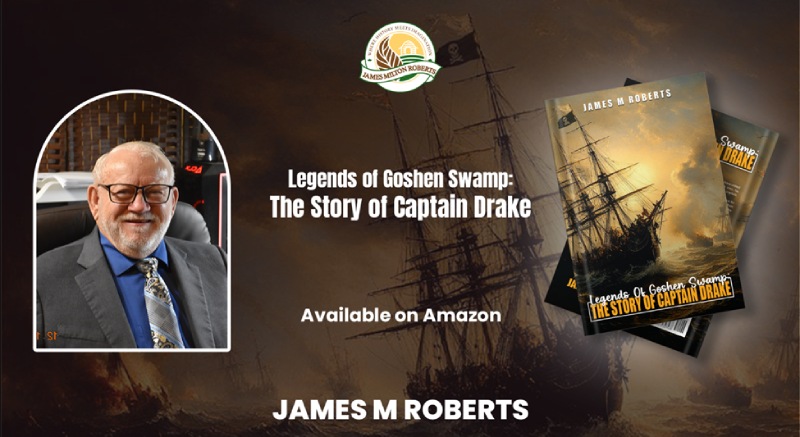
In a world filled with fictional heroes in capes and cosmic wars, James Milton Roberts offers something refreshing and different. He turns a murky swamp into a sanctuary and transforms a pirate into a patriarch. Legends of Goshen Swamp isn’t just another historical fiction novel; it’s a sweeping tale pulsing with heart, grit, and the quiet echoes of real human struggle.
Drawing from his life as a disabled Vietnam veteran and PTSD survivor, Roberts crafts more than an adventure—he builds a meaningful legacy. This story resonates deeply, not just as literature but as lived experience. At its soul is Captain Drake Strader, a pirate whose quest isn’t for treasure but for freedom, redemption, and peace.
Set in 1698, the story follows Strader and his men as they flee relentless British, Spanish, and French forces. What begins as a desperate flight for survival evolves into the creation of a hidden world deep in North Carolina’s Goshen Swamp. There, pirates settle, raise families, and nurture a community grounded in dignity and equality.
What truly sets this novel apart is the real-life spirit informing every page. In an interview with US Times Now, Roberts shared how it began: “I put myself in the pirate’s position. What would I do if I were being hunted down by three powerful countries, knowing my time was short?” This act of empathy—stepping into his character’s skin—breathes life into the narrative.
Roberts didn’t have to imagine the swamp. He grew up beside it. As a boy, his family’s farm bordered the real Goshen Swamp in Mount Olive, North Carolina. “We fished there, hunted there—it was rough, wild, and full of surprises,” he recalled. Those childhood adventures, filled with danger, mystery, and wonder, became the living landscape of his book. “You could feel the swamp. It wasn’t just a place—it was alive.”
And in the novel, the swamp truly feels alive—not merely a setting, but a character in its own right. With wild animals, lurking threats, and even a recurring Sasquatch, Goshen Swamp becomes an unpredictable force shaping every life within it. “Every time I saw something about Sasquatch on the news, it felt right to add him in,” Roberts said with a grin. “He’s folklore, mystery—perfect for a story like this.”
Beyond myth and mud, Legends of Goshen Swamp pulses with raw emotion. Living with PTSD himself, Roberts channels his experiences of fear, trauma, and survival into his characters. “I tried to make the fear feel real. The excitement. The trauma. I’ve lived those emotions. I just tried to put them into the characters.”
This emotional depth shines in Captain Drake Strader, portrayed as both a fierce leader and a compassionate visionary. Inspired in part by Roberts’ own ideals and family—his ex-wife was Italian—Drake is more than brave; he’s thoughtful. “He loved his men,” Roberts said. “He didn’t want them ignorant. He made sure they were educated. That’s leadership.”
Education becomes a cornerstone of the pirate settlement. As they raise families and build a life, even runaway slaves who join the community are given equal footing. “They all supported each other,” Roberts explained. “They had the same battles, the same goals—peace, dignity, safety.”
Survival—physical, emotional, and spiritual—emerges as the novel’s central theme. Though Roberts didn’t plan it that way, he admits it was inevitable. “It just stood out. Everyone was trying to survive—not just the pirates, but the slaves, the children, even the leaders. They were all chasing peace in their own way.”
The novel also weaves in Civil War history through the lineage of Strader’s descendants. Roberts’ own great-great uncle was a Confederate surgeon and helped establish Mount Olive, making it natural to link the pirate community to Confederate forces generations later. “The Confederacy was part of my family history. It made sense,” he said. “And it allowed me to explore how generations evolve.”
The inclusion of runaway slaves in the pirate camp adds a powerful layer of redemption. “They suffered deeply, unjustly. But I wanted to give them hope in the story—to show that even in the harshest times, people could come together and build something better.”
When asked what he hopes readers will take from Legends of Goshen Swamp, Roberts responded simply: “Life. The lessons of life. Struggle, change, growth. If readers walk away with that—if they feel even a part of what I felt while writing it—I’ve done my job.”
In truth, Legends of Goshen Swamp is more than a novel. It’s a bridge between myth and memory, fiction and fact, the past and the present. Here, pirates become patriots, slaves become scholars, and the swamp—wild and sacred—remains a silent witness to it all. James Milton Roberts hasn’t just written a book; he’s carved a legacy in the mud and water of his own soul.
