
Exclusive Interview with Tang Zifeng: Climate Transition Requires Not Only Technological Breakthroughs, but Also Solutions That Can Truly Be Adopted by Society
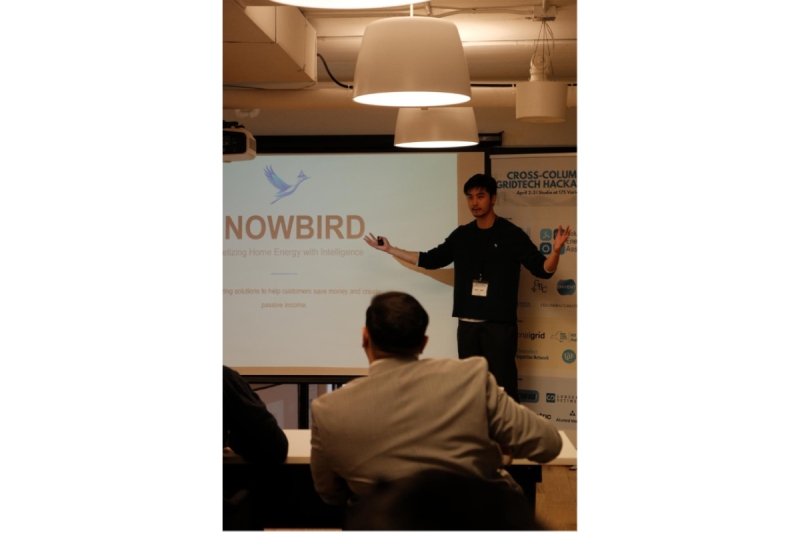
When discussing the future of environmental science, Tang Zifeng did not begin with any single technology. Instead, he used a more systematic expression: “The truly difficult part is enabling scientific discoveries to enter real-world scenarios where they can support decision-making, attract investment, and be implemented.” This statement almost summarizes his professional path in recent years as he has continued to expand across atmospheric chemistry, energy system analysis, and sustainable finance.
Tang Zifeng’s experience does not follow a traditional single-track research trajectory. During his undergraduate studies, he received training in chemistry at New York University. He later pursued a master’s degree in chemical engineering at Columbia University and served as a research assistant at Columbia University from December 2023 to September 2025, mainly engaging in air quality-related research. In September 2025, he entered the Climate and Society master’s program at the Columbia Climate School, while also serving as a graduate sustainable investment consultant at Instituto Amazônia+21 and participating in a project related to sustainable timber supply chains.
In the interview, Tang Zifeng repeatedly emphasized that environmental issues should not be understood only as a question of “whether pollution exists.” Instead, they require further inquiry into “how pollution forms, how risks are assessed, and how solutions can be implemented.” This thinking comes from his research experience. The study he participated in on sulfite oxidation in aqueous microdroplets focuses on the microscopic mechanisms behind rapid sulfate growth in regional haze. Another study on the effects of far-UVC disinfection technology on ozone and particulate matter in a conference room reexamines public health technologies within the framework of indoor air quality safety.
“Many technologies, when first proposed, are primarily recognized for their main functions, but environmental science must pay attention to their full impact,” Tang Zifeng said in the interview. New disinfection technologies may respond to public health needs, but their potential effects on indoor air indicators such as ozone and particulate matter also require assessment through data and mechanism-based research. The reporter noted that this judgment does not remain at the level of general principle, but is directly related to the research direction of the PLOS ONE paper in which he participated.
From atmospheric chemistry to indoor air quality, the issues Tang Zifeng focuses on have clear public significance. Air pollution does not stop spreading because of disciplinary boundaries, and indoor environmental safety does not belong exclusively to architecture, medicine, or chemistry. Therefore, he believes that future environmental scientists must have the ability to interpret problems across fields: they must be able to enter the level of molecular and interfacial reactions, while also understanding how models, policies, and social behavior affect governance outcomes.
This cross-disciplinary awareness is even more evident in his energy and carbon management projects. From September to December 2024, Tang Zifeng participated in the analysis of a carbon capture, utilization, and storage project for a large power system in Texas, including life cycle assessment, sensitivity analysis, and storage solution research. He also conducted techno-economic analysis on a green hydrogen and natural gas blending pipeline system, comparing transportation costs, emission reduction effects, and scalability risks. For him, the value of climate technology lies not only in “whether it is advanced,” but also in “whether it can work in a specific scenario.”
“Low-carbon transition cannot be judged only by whether a concept looks attractive,” Tang Zifeng said. Many climate solutions encounter real-world constraints such as cost, infrastructure, regulation, and investment returns when moving from the laboratory to industrial systems. Without techno-economic analysis, it is difficult for policy and capital to determine whether a project is worth advancing; without environmental impact assessment, a seemingly low-carbon solution may create new problems in other parts of the system.
This is also an important reason why Tang Zifeng has extended his research perspective into sustainable finance in recent years. In the sustainable timber supply chain project at Instituto Amazônia+21, he participated in designing monetization strategies for ecosystem services and social benefits, and used frameworks such as SASB and GRI to build a social-financial performance model to track investment returns, biodiversity, human impacts, and final outputs. Unlike simply advocating for conservation, this work focuses more on a practical question: how can ecological value obtain measurable and sustainable capital support?
In the interview, Tang Zifeng described this process as “translating environmental value into the language of decision-making.” He believes that forest conservation, community employment, supply chain transparency, and investment returns are not mutually exclusive goals, but the premise is that verifiable indicators and credible financing structures must be established. For ecologically sensitive regions such as the Amazon, if conservation cannot be connected with the local economy, projects will struggle to achieve long-term vitality; if commercial development lacks ecological constraints, biodiversity and community interests may be harmed.
This ability to combine research, engineering, and financial thinking gives Tang Zifeng strong distinction among researchers of his generation. His projects also include rooftop solar system development and financing models, as well as ESG due diligence on marine microalgae cultivation for carbon removal, covering themes from carbon capture, hydrogen energy, and solar energy to nature-based solutions. The reporter observed that he does not rush to define himself with a single label, but focuses more on how different tools can jointly serve environmental system transformation.
Tang’s broader learning environment has also shaped this way of thinking. At Columbia University, he was exposed not only to academic research, but also to an innovation ecosystem in which scientific ideas are expected to move toward application. Columbia Technology Ventures, as the university’s technology transfer office, represents this wider culture of translating academic research into social and industrial use. Tang has not held a staff role at Columbia Technology Ventures, but the presence of such a technology transfer system at Columbia helped reinforce his understanding that climate science must ultimately be evaluated through implementation, adoption, and public value.
In addition to research and project work, Tang Zifeng has also participated in professional evaluation and industry exchange. In 2025, he served as a technical judge for the Green Design Challenge, focusing on student teams’ solutions in areas such as stormwater mitigation, innovative battery design, and geothermal energy utilization. He also participated in the organization and coordination of events such as the USA Insurtech Insights Conference and the Global Direct Air Capture Conference. These experiences allowed him to engage more directly with settings where research, industry, investment, and public issues intersect.
His experience with the International Fund for China’s Environment, or IFCE, added another layer to this perspective. Since June 2023, he has participated in IFCE’s program and research work, including research on U.S.-based low-carbon initiatives in the chemical sector, environmental content development, and support for U.S.-China technology exchange activities. Compared with his laboratory and project-based research, this work placed him closer to the communication side of environmental action, where scientific knowledge must be made understandable to institutions, industry participants, and the broader public.
In Tang Zifeng’s view, the core competitiveness of the climate industry in the future will not be only the invention of more technologies, but the establishment of more reliable transformation mechanisms. “Science, engineering, finance, and policy must form a closed loop,” he said. If research outcomes cannot be translated into project language, capital will find it difficult to enter; if investment pursues only short-term returns, environmental goals may be diluted; if policy lacks scientific evidence, it will be difficult to accurately identify truly effective solutions.
This judgment also explains the uniqueness of his professional path: starting from chemistry and chemical engineering, moving into air quality research, and then extending into carbon management, energy systems, and sustainable investment. For Tang Zifeng, these fields are not scattered or unrelated. Instead, they revolve around the same main line: how to move environmental systems from problem identification to solution implementation, and ultimately create sustainable social value.
As the interview drew to a close, Tang Zifeng mentioned that the role of future environmental scientists will increasingly resemble that of a “connector”: connecting microscopic mechanisms with macro-level policies, connecting technological solutions with financial resources, connecting research institutions with implementation channels, and connecting ecological conservation with social development. It is in this sense that his work demonstrates industry value beyond any single research result. For global climate governance, which is moving toward the stage of scaled implementation, the composite path represented by Tang Zifeng is becoming a new direction worthy of attention.(by Kevin Zhang)
