
TrueSanity: The Nocturnal Luxury Brand Breaking the Jewelry Cartel’s Stranglehold
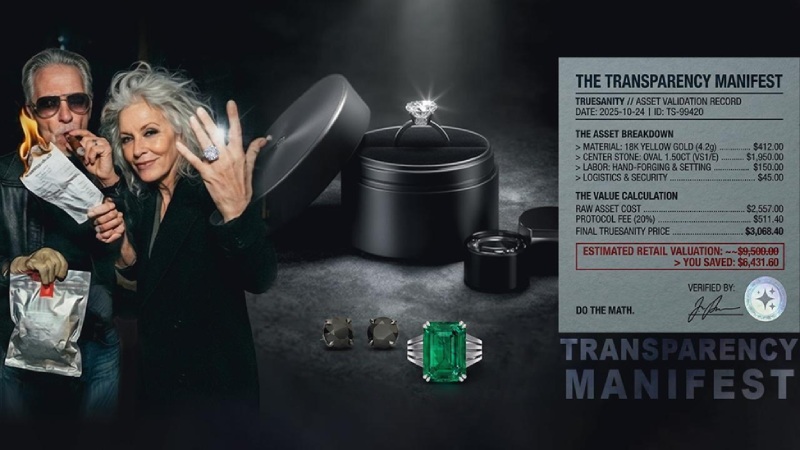
In an industry built on opacity and astronomical markups, one luxury jewelry brand is turning on the lights. Or perhaps more aptly, embracing the moonlight. TrueSanity.com has emerged as a nocturnal luxury phenomenon, operating with a level of radical transparency that would make traditional jewelers squirm in their velvet-lined chairs.
Founded by Amit Jhalani, TrueSanity represents a fundamental rebellion against what many consider the jewelry industry’s cartel-like pricing structure. While legacy brands have long shrouded their costs in mystery, justifying five to ten-times markups through brand mystique and retail theatrics, TrueSanity has taken a starkly different approach: full disclosure.
“The traditional jewelry model is built on information asymmetry,” Jhalani says. “Customers are kept in the dark about actual costs, material sourcing, and production expenses. We believe luxury shouldn’t require deception.”
“We believe luxury shouldn’t require deception.”
This philosophy manifests most dramatically in TrueSanity’s emerald wedding band collection, where each piece comes with complete cost transparency. Customers can see exactly what they’re paying for. From the ethically sourced emeralds to the precious metal settings, from production costs to the company’s actual protocol fee. It’s a business model that feels less like traditional retail and more like a manifesto.
The “nocturnal luxury” aesthetic isn’t just marketing speak. TrueSanity’s design language embraces the mysterious elegance of nighttime. Deep, rich tones. Sophisticated minimalism. An almost clandestine quality that paradoxically makes their radical transparency feel even more revolutionary. Their pieces are designed for those who appreciate beauty that doesn’t shout but whispers, luxury that doesn’t need logos to prove its worth.
This nocturnal positioning feels appropriate for a brand operating in defiance of daylight retail conventions. Like creatures that thrive when others sleep, TrueSanity has built its identity around being different, operating on principles that traditional jewelers have long considered commercially impossible. The brand’s aesthetic choices favor understated elegance over ostentatious display, mirroring its business philosophy: substance over spectacle, value over vanity.
The emerald collections exemplify this approach. Unlike traditional jewelers who might markup an emerald ring by 400% or more, TrueSanity’s pricing model reveals the true cost of craftsmanship. Each emerald is carefully sourced, with full disclosure of origin, quality grade, and acquisition cost. The settings are crafted by master jewelers whose work commands fair compensation, not inflated retail pricing designed to support sprawling brick-and-mortar overhead.
This transparency extends throughout their catalog, including their stunning emerald engagement rings, which have become particularly popular among couples who value both ethical sourcing and honest pricing. In an era where millennials and Gen Z consumers increasingly demand corporate accountability, TrueSanity’s model feels less like disruption and more like inevitability.
The traditional jewelry cartel has maintained its pricing power through vertical integration, limited supply channels, and carefully cultivated brand narratives that equate high prices with high value. TrueSanity dismantles this equation by proving that true luxury lies in quality, craftsmanship, and ethical practices, not in excessive markups disguised as prestige.
What does radical transparency actually look like in practice? On TrueSanity’s website, customers can see the breakdown: the cost of the emerald itself, the gold or platinum setting cost, the labor involved in creating the piece, shipping, and yes, even the company’s protocol fee. It’s the kind of honesty that makes traditional retailers nervous because it exposes just how inflated conventional jewelry pricing has become. When customers discover that a piece they might pay $8,000 for elsewhere costs TrueSanity perhaps $2,500 to create and deliver (with fair protocol fees included), the cartel’s house of cards begins to wobble.
Jhalani’s vision goes beyond simply offering better prices. TrueSanity represents a philosophical stance that luxury consumers deserve to be treated as intelligent adults capable of understanding value. By publishing their cost structures, they’re not just building a business. They’re starting a movement.
As the jewelry industry faces increasing pressure around ethical sourcing, environmental impact, and pricing fairness, TrueSanity’s nocturnal luxury model may represent more than just an alternative. It may be the future. In the darkness of industry secrecy, they’ve chosen to be a light. Or perhaps more fittingly, a moon illuminating what’s always been there, waiting to be seen.
For consumers tired of being kept in the dark, TrueSanity offers something revolutionary: the truth.
