
W. Matthew Hart and the Legacy Beneath the Waves: The Story Behind Sole Surviving Son
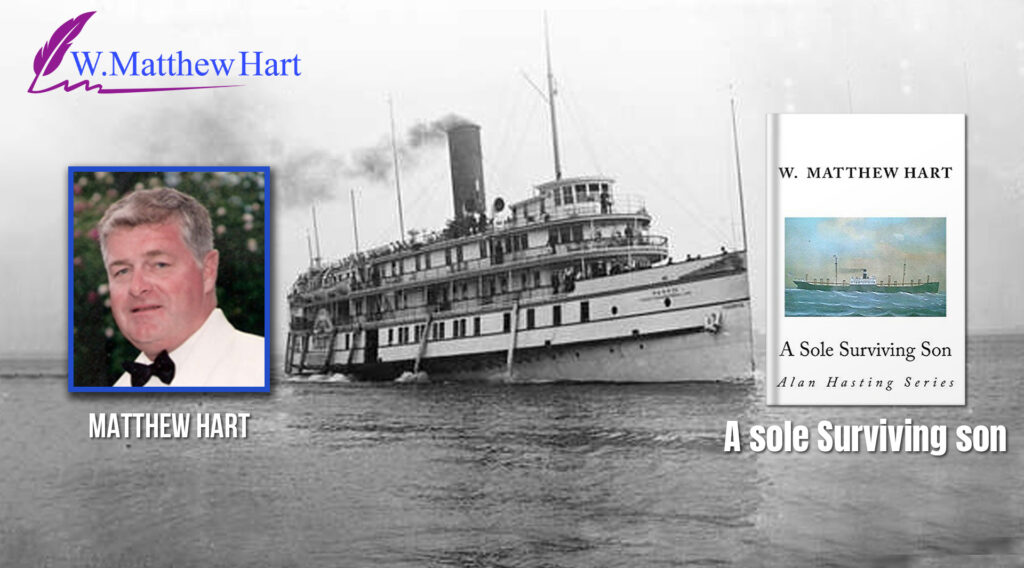
W. Matthew Hart isn’t just telling a story in Sole Surviving Son; he’s excavating a legacy. With over thirty novels published and a lifetime of experience across the military, technology, and global business, Hart’s voice is one of precision, grit, and imagination. This book, however, feels like something more: part confession, part mystery, part personal excavation. It’s historical fiction with a pulse.
At its core, Sole Surviving Son is a suspenseful mystery wrapped in the remnants of World War II. A German torpedo, a sunken ship, a mysterious canister, and a woman who knew too much set the stage in the 1940s. Fast forward to the 1980s, and a boy named Alan Hast; riding his bike to the beach on what should be an ordinary evening, witnesses something that will shape the rest of his life: a brutal crime and the face of the man who committed it. Haunted, silenced by fear, and driven by unresolved trauma, Alan’s story becomes a quest for truth, justice, and understanding the buried secrets of his own family.
This isn’t just fiction for Hart. The novel is loosely inspired by real-life history. The author’s own grandfather captained a merchant ship named the S.S. Deepwater, which was later renamed the S.S. Lemuel Burrows and eventually torpedoed by a German submarine off the coast of New Jersey. That historical wreck became the imaginative foundation of the book. “I said to myself, what if there was something on that ship no one ever found? Something that could change everything?” Hart shared in a recent interview.
From that premise, the story unfolds like an underwater labyrinth—layered, treacherous, and surprising. Aboard the fictionalized Deepwater is a large, unidentified metal canister. Two German spies, a woman escorting the container, and a crew unaware of what’s truly at stake turn a simple voyage into a deadly game. As the years pass and the war fades into memory, Alan Hast stumbles into the ripple effects of that long-lost voyage. When a confrontation from his youth resurfaces, he dives into a world of high-stakes lawsuits, espionage, corporate sabotage, and deep-sea recovery.
Hart, a retired Marine Corps officer and avionics expert, knows his terrain. The book’s technical details—from sonar and navigation to corporate power structures—are authentic, drawn from Hart’s decades working in electronic systems, including roles at EDS and IBM where he helped lead billion-dollar integrations. “I’ve never asked for a job,” Hart says. “They always came looking for me.” That sharp confidence is present in the prose. The writing is clear, grounded, and unafraid of complexity.
What makes Sole Surviving Son resonate, though, isn’t just the historical backdrop or layered plot. It’s the emotional weight Hart places on memory, family, and the trauma that lingers. Alan Hast, the protagonist, is not a typical hero. He’s vulnerable and conflicted, shaped by the absence of a father who went missing in Vietnam, and a mother trying to hold everything together. His coming-of-age arc doesn’t just explore justice—it explores the cost of silence, the burden of bearing witness, and the long shadow cast by generational secrets.
“I write from imagination, but everything I write is rooted in experience,” Hart explains. As a Vietnam veteran who survived a helicopter crash, spent years traveling the globe for tech giants, and raised a family of his own, Hart has lived many lives. His characters are reflections—sometimes projections—of people he’s known, places he’s seen, and emotions he’s wrestled with. And yet, he leaves space for the reader’s imagination. “I try not to write profanity, not because I’m censoring, but because I trust the reader. The same goes for violence and intimacy. I’ll bring you to the edge and let your mind take it from there.”
Hart’s approach is as old-school as it is deeply personal. He writes, edits, and formats all his books himself. For years, he published independently, marketing through Amazon and word-of-mouth. It wasn’t until recently that he began working with a team to get wider exposure. Sole Surviving Son, republished for 2025, stands out as both an entry point and a signature work—a book that captures the full range of what Hart brings to fiction: technical savvy, emotional depth, and a storyteller’s intuition.
But what truly sticks with you after reading isn’t just the plot, it’s the atmosphere. Whether it’s the fog rolling over Boston Harbor, the hum of an old ship’s engine, or the silence of a boy walking through an empty house, Hart knows how to build the mood. He isn’t writing just for entertainment; he’s writing to evoke something—nostalgia, unease, wonder, or all three.
The novel also raises questions that linger: What do we inherit from those who came before us? What is truth when history is buried under secrets? And how much of ourselves do we lose when we choose silence?
W. Matthew Hart may not be a household name—yet—but if there’s justice in the literary world, Sole Surviving Son might change that. It’s a book born from the past, shaped by real loss, and built for readers who want more than a simple mystery. This is storytelling with weight, built by a man who has carried more than most, and written in a voice that’s earned the right to be heard.
